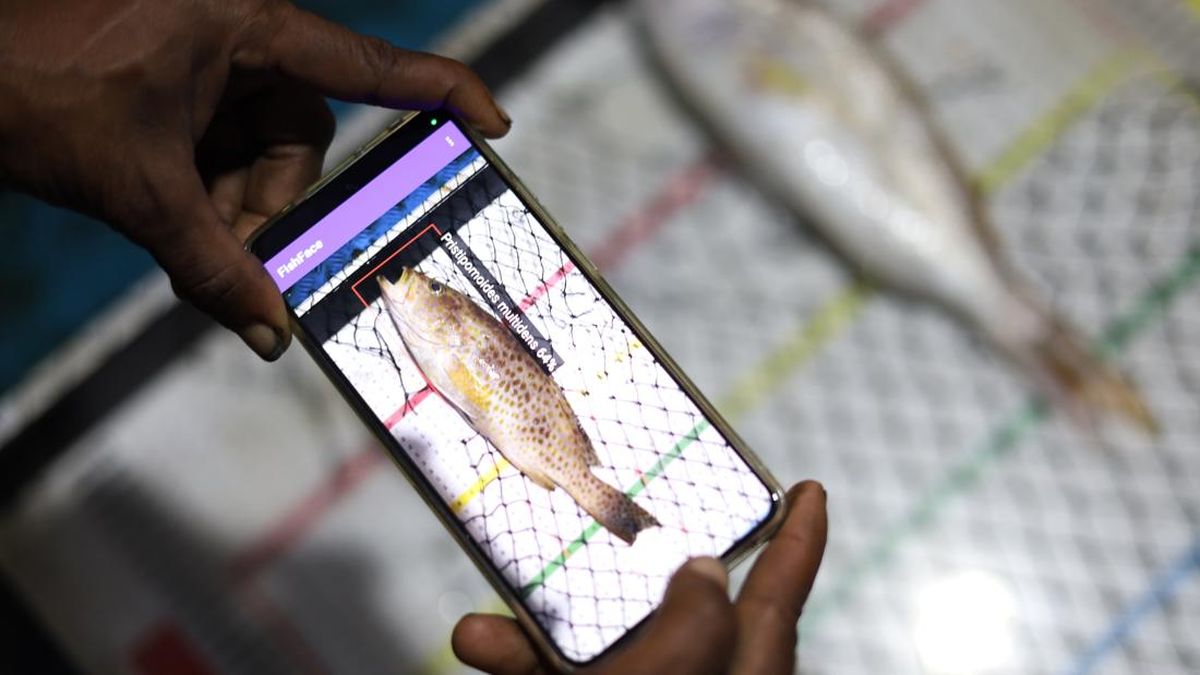
Fishers in Les village in Bali are using the artificial intelligence app FishFace to record their catches, as Indonesia's fisheries ministry adopts the fish recognition technology in its e-Logbook Version 3 reporting app.
I Ketut Kartasa, secretary of the Segara Gunung fishers' group in Buleleng, takes an Android phone and a measuring tape to sea. After catching skipjack or tuna around fish aggregating devices, he measures and photographs the fish. The app scans its features and records its species, length and GPS coordinates for upload to a central database.
Weak signals and waves that rock the boat can make the work difficult. Ketut said that when a photograph or upload fails at sea, he tries again after reaching shore. He said recording the catch had also helped fishers pay closer attention to the condition of the fish they land.
Six of the group's 15 fishers take part in the recording programme. The Indonesian conservation foundation Yayasan Konservasi Alam Nusantara (YKAN) provides the group with 5 million rupiah a month: 70% goes to active data collectors and 30% to the group fund for equipment maintenance.
YKAN began community-based fisheries recording in 2014 through the Crew-Operated Data Recording System (CODRS). Senior sustainable fisheries manager Glaudy Perdanahardja said FishFace was developed to reduce errors in manual species identification. Its first version in 2017 used a large machine on industrial vessels or at processing plants, before the technology became a mobile app. Together, CODRS and FishFace have involved more than 1,500 fishers across Indonesia.
Fisheries ministry official Syahril Abd. Raup said varying local names for fish had contributed to reporting errors. The ministry's e-Logbook Version 3 uses FishFace recognition to identify species from images, particularly tuna and snapper. The ministry regards the data as a basis for its quota-based measured fishing policy.