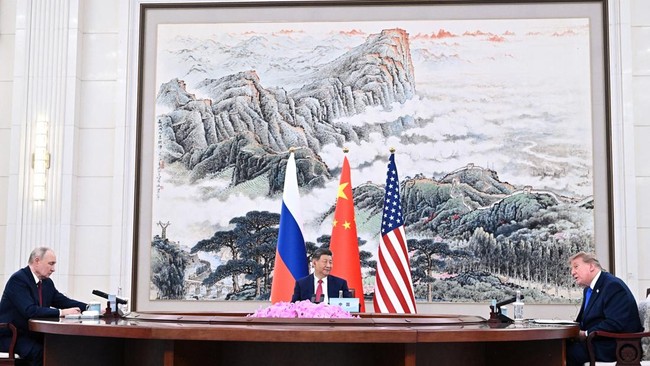
US President Donald Trump, Chinese President Xi Jinping and Russian President Vladimir Putin ended a meeting in Shenzhen, China, on Thursday, November 19, 2026, with a peace declaration that contained no concrete agreement to reduce nuclear arsenals or resolve major ongoing conflicts.
The three countries reaffirmed that a nuclear war cannot be won and must never be fought. They also pledged dialogue on reducing nuclear risks and preventing the spread of nuclear weapons, but set no timetable or mechanism for arms reduction talks. CNBC Indonesia, citing Reuters, reported that the declaration concluded a three-day diplomatic trip by Trump in Asia.
The declaration also called for reform of the United Nations, greater supplies of fuel products for all countries and continued legal immunity for state officials in international courts. The fuel pledge is relevant to Indonesia as one of the countries covered by the broad commitment, although the report gave no implementation details or evidence of an effect on Indonesian supply or prices.
The document did not address Russia's war in Ukraine or the US military conflict with Iran. At a news conference after the meeting, Putin acknowledged that it set no ambitious targets and said no party would be compelled to follow its decisions. Chinese Foreign Minister Wang Yi said coordination would continue among officials.
Daryl Kimball, executive director of the US-based Arms Control Association, welcomed the statement on nuclear war but said disarmament diplomacy required action beyond rhetoric. Jonathan Eyal of the Royal United Services Institute identified the provision on international courts as a significant part of the declaration. The International Criminal Court previously issued an arrest warrant for Putin over alleged war crimes in Ukraine; Moscow denies the accusations.